War never changes.
Life does.
WASTELAND BULLETIN // PORTLAND, CASCADIA REGION // 2279
Fallout: Evergreen is a Fallout roleplay set in the Pacific Northwest, specifically in the Columbia Basin, which consists of South Portland and the surrounding outskirts in the year 2279. Once a thriving city, the remaining southern part of Portland has become a dangerous and fractured wasteland filled with raiders, feral ghouls, super mutants, and countless other threats. The New California Republic seeks to establish order through Fort Markhum, while a small chapter of the Brotherhood of Steel safeguards valuable pre-war technology. Independent communities such as Oregon City remain wary of outsiders, and the Followers of the Apocalypse work tirelessly to provide aid and hope to those living among the ruins. Despite the dangers, many believe that this region can be reclaimed.
Whether you choose to serve a faction, establish your own group, become a merchant, wastelander, or simply just want to survive another day, your actions will shape the future of the Columbia Basin. While Fallout: Evergreen follows an overarching story, it still allows opportunities for players and factions to make decisions that will influence how events unfold and leave their mark on the region. Please see the rest of the website on how to properly roleplay within Fallout: Evergreen!
To get started, join the Discord and submit your character for approval. Once approved, you're in.
SHORTCUTS
GENERAL LORE
Understand the world before you step into it.
FACTION GUIDE
How factions work, how to join, and how to play them right.
ROLEPLAY GUIDE
What's expected of you before you drop into the wasteland.
CHARACTER RULES
What your character can be and where they can come from.
Information & Lore / General Lore
INFORMATION & LORE
General Lore
The full history of Portland, the bombing, and the years since, up to 2279: what's known, what's rumored, and what's still buried.
BEFORE THE WAR
Before the Great War, Portland was one of the Pacific Northwest's most important industrial and military centers. During the Anchorage Campaign, the city became a major logistics hub responsible for producing weapons, military vehicles, robotics, and advanced electronics for the United States military. Portland's growing technology sector earned it the nickname the Silicon Forest, and with it came military installations, government laboratories, biomedical research centers, and defense contractors that made the city a critical strategic target. The Meridian Biomedical Research Complex, the largest medical and research facility in the region, sat beneath the South Portland Hospital, one of many institutions that made Portland worth bombing.
THE GREAT WAR
When the Great War began on October 23, 2077, northern Portland was struck directly by a nuclear warhead. The blast leveled much of the northern city, and the fires, shockwave, and radioactive fallout that followed left the rest of Portland heavily damaged and nearly impossible to survive in. The damage was not uniform. Ashcreek, in the ruins of the northern blast zone, still harbors an undetonated nuclear bomb that has been leaking radiation for two centuries. Northern Portland is effectively a dead zone. Irradiated, ghoul-infested, and avoided by almost everyone with the sense to know better.
Southern Portland fared better. It survived intact enough to be lived in, fought over, and slowly rebuilt. Over the following centuries, radiation levels declined across much of the region and small settlements began to emerge throughout the ruins as survivors learned to navigate what remained.
THE COLUMBIA BASIN
The Columbia Basin is unlike most of the wasteland. Dense forests, constant rainfall, overgrown highways, and urban ruins slowly being reclaimed by nature define the region. It is a place where nature never stopped fighting back. Vines through broken windows, trees splitting asphalt that hasn't seen a car in two hundred years. The air smells like rain and pine and rust all at once. There are stretches of the Outskirts where, if you didn't know any better, you might forget the world ever ended. Then something moves through the trees and you remember exactly where you are.
Most people living in the Columbia Basin aren't soldiers or scholars. They're traders running caps between settlements, mercenaries hired to escort caravans through stretches of road nobody else will walk, farmers scratching out a living on the edge of the ruins, scavengers picking through collapsed buildings for anything worth selling. Life out here is hard in ways that have nothing to do with factions or politics. Food has to be hunted, traded, or scavenged. Clean water is rarer than the rivers on the map would suggest. Winters push people indoors and kill those without shelter. The wasteland doesn't care what faction you belong to. It just cares whether you're prepared for it.
Southern Portland has become largely traversable, though it remains incredibly dangerous. Downtown Portland is one of the most hazardous stretches of the Columbia Basin. Feral ghouls, raiders, super mutants, unstable structures, and pockets of radiation make it almost entirely impassable to anyone without serious firepower and a good reason to be there. Beyond the city lie the Outskirts, where forests, rivers, and mountains conceal mutated wildlife, abandoned settlements, and dangers that don't announce themselves until it's too late. People go into the Outskirts for all kinds of reasons. Hunting. Salvage. Running from something. Most of them make it back. Some of them don't, and nobody goes looking.
OREGON CITY
For nearly two centuries, Portland remained little more than scattered settlements surrounded by ruins. The oldest surviving settlement is Oregon City, founded almost immediately after the bombs fell by Police Chief Joseph McCall, who united surviving civilians, police, and military personnel into a single organized community before anyone else could fracture them apart. They secured stockpiles of police and military equipment, fortified the old government district, and established a direct democracy that has held ever since.
Oregon City has survived raider attacks, political pressure, and two centuries of wasteland attrition. In 2274 a motorcycle raider gang called the Gypsies launched one of the most serious assaults the settlement had faced in generations, killing Police Captain Anthony Volkman before being driven out. The city survived, but it reinforced what Oregon City already knew: the world outside its walls is not getting safer. Under current Mayor Chael Dane, Oregon City remains fiercely independent, cautious of outsiders, and deeply suspicious of anyone who looks like they want to be in charge of something that isn't theirs.
THE FACTIONS ARRIVE
In 2264, a small Brotherhood of Steel scouting party led by Paladin Silas Thorne was sent north from Lost Hills after pre-war records pointed to Portland's technological and military importance. For two years the scouts surveyed the ruins before discovering the South Portland Hospital and evidence of the Meridian Biomedical Research Complex beneath it. In 2266, the Portland Chapter of the Brotherhood of Steel was formally established. Thorne became its first Elder. Fort Sanders was built near Meridian and has served as the chapter's headquarters ever since.
The Brotherhood spent years attempting to breach Meridian. Their efforts were slow and costly. The hospital above is occupied by mutants and the complex beneath is still protected by functioning pre-war security systems. A major breach attempt ended in disaster, killing 12 members. By 2279 the chapter has recovered to roughly 30 personnel. They are patient now. They do not waste lives.
In 2272, the New California Republic sent a small expeditionary force under Colonel Jet Morris north to Eugene. The NCR fought a brutal two-month campaign to take the city from hostile tribes and raiders, then turned Eugene into the trade capital of its northern expansion. Morris stepped down from military command to become Governor of the Oregon Territories. His successor, Colonel Daniel Erwin, planned a full push into Portland, but before it could happen, the First Battle of Hoover Dam pulled most of NCR Oregon's manpower south to the Mojave.
With only 30% of his original force, Erwin settled for fortifying Markhum High School as Fort Markhum. By 2277 the NCR had established its primary military installation in Portland, attracting settlers and traders and forming a small civilian sector within its walls. Governor Morris continues pushing for expansion under the argument that new trade routes will help fund the Mojave campaign. The NCR is stretched thin. It is also the most organized military presence in the Columbia Basin, and that matters.
The Followers of the Apocalypse arrived alongside the NCR in Eugene, providing medical care, education, and humanitarian aid. By 2275, growing frustration with NCR corruption and its tendency to prioritize its own citizens over outsiders drove many Followers to break away and move independently into Portland. Under Regional Director Moliterno, they established the Underclinic in the city's sewers alongside the Rivermen, a former raider tribe they had reformed and educated. The Underclinic became one of the most valuable humanitarian settlements in Portland, until the Ironband attacked and overran it in what became known as the Underclinic Massacre. The chapter lost its most experienced members. Many returned to California.
Those who stayed rebuilt under new Regional Director Sofia Parm. They retook the Underclinic, fortified it, and made clear they would not be driven out again. The Oregon Followers are still humanitarian first. They are no longer unarmed.
Cascadia Radio has been a voice in the region for nearly 20 years. Founded by KeSean Beaumont, the station broadcasts from southern Portland: news, weather, travel warnings, advertisements, and music. It is officially independent and officially neutral, though it has never been shy about criticizing the NCR on air. Its signal reaches much of the Columbia Basin. Most people in the region know what Cascadia Radio is.
2279
No single faction controls the Columbia Basin. The NCR pushes north, the Brotherhood works toward Meridian, Oregon City holds its walls, and the Followers try to keep people alive in the middle of it. Trade caravans connect the scattered settlements of the region, with both bottle caps and NCR dollars accepted as currency. Magnolia Trade Outpost sits along the western road into Portland, independent and neutral, though NCR expansion into the surrounding territory is making that neutrality harder to hold.
Whether you're traveling with a caravan, working a contract, running from your past, or just trying to make it to the next settlement before dark, the Columbia Basin has a place for you. The world here is dangerous, complicated, and very much alive. What you do with it is up to you.
In recent months, a word has begun appearing across the Columbia Basin. Carved into doors. Scratched into roads. Written on walls of places where people used to be. Nobody knows who's leaving it. Nobody knows what it means. Traders pass it along without thinking much of it. Cascadia Radio mentioned it once and moved on. Most people shrug it off.
Evergreen.
Information & Lore / Location Guide
INFORMATION & LORE
Location Guide
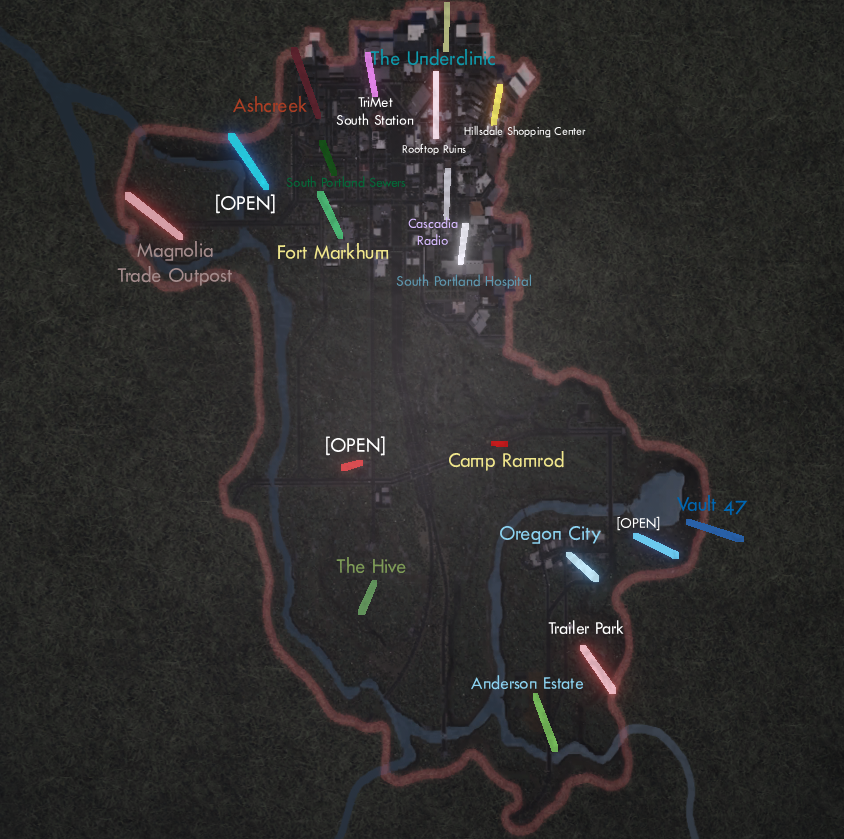
A breakdown of the locations within the region of Fallout: Evergreen as of 2279. Locations marked [OPEN] are unclaimed and designed for roleplayer factions. Contact synth3tlc or Wildo to make a request.
SAFE
VARIABLE
CAUTION
DANGER
UNKNOWN
THE LAY OF THE LAND
Not every street or trail gets a name or a danger rating, that's the point. The map below only marks the landmarks. Everything in between is just the world, and it doesn't get safer or worse all at once, it shifts depending on where you are and whether you're still in the city or you've left it behind.
THE RUINS
Stay close to Fort Markhum and the NCR's presence does most of the work for you. Patrols and proximity to the garrison keep the worst of it from wandering too close. Push further north, deeper into the blast-damaged core, and that protection stops meaning anything, not because anyone's taken over up there, but because nobody has. It's chaos: a raider camp squatting in one building, ghouls denning in the next, mutated wildlife claiming whatever's still got a roof. Nothing about it is organized. That's exactly what makes it unpredictable.
Be warned: none of this is a guarantee either way. A quiet block can turn ugly without notice, and a street two minutes from Fort Markhum's walls isn't automatically safe just because of where it sits on the map.
THE OUTSKIRTS
Step outside the ruins and the wasteland changes completely. This isn't the dead, ashen woodland you'd find elsewhere. Portland took the direct hit, the forest around it didn't, and it grew back exactly the way a Pacific Northwest forest should: thick, green, and genuinely alive.
Out here the danger isn't factions or gunfights, it's distance, and that doesn't make it safer. Nobody's patrolling these woods, and nobody's coming if something goes wrong, which just means whatever finds you gets longer to finish the job before anyone hears about it. Yao Guai, radstags, a band of super mutants that never bothered settling down, a raider gang too far out for the NCR to bother with, mirelurks if you're near enough to water, or something nobody's bothered to name yet. None of it is rare out here, and none of it announces itself until it's too late to walk away.
These outskirts are also where most of what's left to actually find still sits: old logging camps nobody's touched in decades, hunting cabins, the kind of small forgotten places that never made it onto anyone's map. Fewer gunfights out here. More questions about what's still standing, and who, if anyone, found it first.
Treat all of this as a general sense of where the odds lean, not a verdict on any one street or trail.
NORTHERN RUINS // BLAST-DAMAGED CORE
The Underclinic
SAFEFOLLOWERS OF THE APOCALYPSE
The Oregon Chapter of the Followers of the Apocalypse runs their primary base of operations out of the sewers beneath southern Portland. The Underclinic provides medical treatment, education, and humanitarian aid to anyone who walks through — faction affiliation, citizenship, and caps are irrelevant. If you need help, they help you.
The clinic was attacked and overrun by the Ironband in what became known as the Underclinic Massacre. Many veteran Followers and Rivermen were killed. The survivors retook it, rebuilt it, and fortified it. The Rivermen now patrol the surrounding sewer systems to keep raiders away. The Followers are still here. They are not planning on leaving again.
TriMet South Station
VARIABLEMOLERAT INFESTATION
A dead transit station overrun with molerats. A decent hideout, if you can stomach the company.
Hillsdale Shopping Center
DANGERSCAVENGING SITE
Picked-over retail ruins. Worth raiding for supplies, but hostile creatures and raiders make it a genuine risk.
Rooftop Ruins
CAUTIONRAIDER-DESTROYED
What's left of a once-independent settlement, wiped out by raiders. Elevated, exposed, and a reminder of what happens out here without backup.
South Portland Sewers
VARIABLEMUTANT SIGHTINGS
Super mutants and other mutant creatures have been spotted throughout. Some stretches are safer than others; knowing which is the trick.
Cascadia Radio
SAFEREGIONAL BROADCAST
Home of Cascadia Radio, the region's main broadcast signal: the Evergreen wasteland's answer to GNR. Whoever holds this site controls what the wasteland hears.
South Portland Hospital
CAUTIONMERIDIAN BIOMEDICAL RESEARCH COMPLEX
The largest medical and technological facility in the Columbia Basin, and one of the most dangerous places in southern Portland. The Meridian Biomedical Research Complex is located within these walls. The Brotherhood of Steel established Fort Sanders nearby specifically because of what this building contains. What's beneath it remains sealed.
Ashcreek
DANGERUNDETONATED BOMB
Ruins of the small town of Ashcreek, now home to an undetonated nuclear bomb leeching radiation into the area. Feral ghouls and other mutants thrive here. Extremely dangerous.
Fort Sanders
CAUTIONBROTHERHOOD OF STEEL HQ
The Portland Chapter of the Brotherhood of Steel's regional headquarters, built into a fortified pre-war building near the South Portland Hospital. The location was chosen deliberately — Fort Sanders sits as close to Meridian as the Brotherhood could manage while still maintaining a defensible position.
From here, Elder Silas Thorne runs the chapter's operations across southern Portland. The fort houses terminals, workshops, communications systems, power equipment, and living quarters for the chapter's roughly 30 personnel. Approaching without Brotherhood authorization is not recommended.
Forward Station Delta
CAUTIONBROTHERHOOD RECON CAMP
A Brotherhood of Steel recon camp set atop a rundown tall building, watching the ruins from above.
Outpost Edith
CAUTIONBROTHERHOOD SCOUTING BASE
The Brotherhood's second-largest holding in the region, built into another abandoned building. Functions as a scouting post and secondary base.
WESTERN APPROACH
Magnolia Trade Outpost
SAFEINDEPENDENT TRADE POST
One of the most important neutral trading posts along the road into Portland, Magnolia has been operating for more than 50 years. It traces its origins back to Astoria's Goods, a caravan company out of ruined Astoria that gradually built a permanent settlement along a major route into the Columbia Basin. The settlement took its name from the flowers still found growing throughout parts of Oregon.
Magnolia trades in almost everything: food, water, weapons, ammunition, medicine, salvage, and general supplies. Caps are the primary currency. The outpost is run by a small trade council made up of the descendants and remaining members of Astoria's Goods, supported by its own guard force. Caravan companies passing through are frequently contracted for additional security.
Magnolia's entire reputation is built on one thing: neutrality. Anyone can trade here so long as they follow the settlement's rules. Political conflicts, faction disputes, and personal grudges stay outside the gates. The Brotherhood watches what technology passes through its markets. The Followers use it as a humanitarian supply stop. Cascadia Radio keeps informants here. Most travelers heading into Portland pass through Magnolia first.
That neutrality is under pressure. The NCR claimed the surrounding territory without annexing the outpost itself, and many residents fear taxation or political control is only a matter of time. Relations worsened significantly after an NCR outlaw attacked the outpost. Though quickly arrested and imprisoned, the incident created serious backlash among traders and residents who blamed NCR expansion for bringing instability to what had been neutral ground. The NCR has not moved against Magnolia directly. The tension remains.
Fort Markhum
SAFENCR MAIN BASE
The NCR's primary military installation in Portland, built into the ruins of Markhum High School — a building that previously served as a quarantine site during the pre-war New Plague outbreak. Fort Markhum is both a military fortress and a functioning settlement, with a small civilian sector that has grown up around the garrison since the NCR's arrival in 2277.
The fort houses NCR troopers, Rangers, and civilian personnel under the command of Colonel Daniel Erwin. Firearms carried by non-NCR personnel are not permitted inside the walls. The NCR patrols the surrounding area and considers much of the western approach to Portland under its jurisdiction.
[OPEN] - West
UNCLAIMED
A large brick construction building just outside the city, built like a small faction fort. No one's claimed it yet.
SOUTHERN OUTSKIRT // INTACT, POPULATED
Camp Ramrod
SAFENCR SOUTHERN CAMP
The NCR's southern camp, holding position and maintaining a presence in the outskirt.
[OPEN] - Central
UNCLAIMED
An abandoned motel along the central corridor. No one's claimed it yet.
The Hive
UNKNOWN
What this place is, and who (or what) runs it, isn't public knowledge. Find out the way everyone else will: in character.
Oregon City
SAFESTABLE • DEMOCRATIC
The oldest surviving settlement in the Columbia Basin and one of the safest places to be in the region. Oregon City was founded almost immediately after the Great War by Police Chief Joseph McCall, who united civilian survivors, police, and military personnel into a single organized community before anyone else could fracture them apart.
The settlement runs as a direct democracy under current Mayor Chael Dane. The Oregon City Police Department serves as both law enforcement and military defense. Outsiders are screened before entry, not out of hostility, but out of hard-won experience. Refugees who prove themselves are welcomed. The settlement has a clinic run by the Followers of the Apocalypse, who were accepted into Oregon City in 2278 and became close allies. The Anderson Estate supplies food and water in exchange for protection.
Oregon City has rejected NCR advances and has no intention of becoming Republic territory. Its independence is not a negotiating position.
[OPEN] - Abandoned Quarry
UNCLAIMED
An abandoned quarry near the vault entrance. No one's claimed it yet.
Vault 47
SAFEVAULT-TEC
A Vault-Tec vault in the southern outskirt. Vault 47 has been through two revolutions in its history and is currently governed by an elected democracy that is only five years old. The effects of what came before are still very much present.
The Vault is partially open. Approved residents and expedition teams come and go regularly, mostly to gather supplies the Vault can no longer produce internally after more than two centuries of operation. Outsiders are never permitted inside under any circumstance. The Vault's location is kept secret, all outside trade happens on the surface, and the Vault will not open its doors for any reason, including leverage over a resident.
What exactly went on inside over the past two hundred years is not widely known on the surface.
Trailer Park
VARIABLEABANDONED
An abandoned trailer park. Nothing more, nothing less, for now.
Anderson Estate
SAFEALLIED TO OREGON CITY
A family-held property that's fended off every invader and stayed independent. Aligned with Oregon City, providing the settlement with food and water.
Information & Lore / Wasteland Threats
INFORMATION & LORE
Wasteland Threats
Creatures, hazards, and dangers roaming the Evergreen wastes that every survivor should know about.
None of this guarantees an encounter just by existing. See the Roleplay Guide for how danger actually plays out.
SURVIVAL
Before anything out there finds you, the wasteland itself is already working against you. None of these need a monster behind them to be dangerous.
Starvation
CAUTION
Food doesn't grow itself out here, not safely anyway. Hunting, trading, and scavenging are what keep most survivors fed. Fall behind on all three at once and it catches up slower than a raider, but just as surely.
Dehydration
CAUTION
Clean water is rarer than the rivers on the map would suggest; plenty of what's running through the Columbia Basin isn't safe straight from the source. Go without long enough and it'll put you down before most predators get the chance to.
Exposure
VARIABLE
Summers in the Cascadia wilds are forgiving. Winters are not. Without real shelter or a way to stay warm, the cold does what plenty of the wildlife on this list can't manage on its own.
Radiation
DANGER
Not every hot zone comes with a warning sign. Ashcreek's the worst of it, but irradiated pockets are scattered well beyond it, and the damage adds up long before it ever turns anyone into a ghoul.
MUTANTS
Feral Ghouls
DANGER
Once human, warped past recognition by decades of radiation exposure. Whatever mind they had left is gone, replaced by raw aggression. Found in heavy concentration around Ashcreek, drawn to the radiation leaking from the buried bomb there.
Super Mutants
DANGER
Hulking, inhumanly strong, and nearly impossible to reason with once they've spotted you. Sightings cluster in the South Portland Sewers, where they share the dark with whatever else has made a home down there.
Centaurs
CAUTION
The same process that makes super mutants, gone wrong. Fused, boneless masses of flesh that move slow but won't stop coming once they've noticed you. They don't wander far on their own, so finding one usually means super mutants aren't far off either.
WILDLIFE
Yao Guai
DANGER
The Columbia Basin was bear country long before the bombs fell. What's left of that bloodline now runs bigger, faster, and considerably angrier than anything that used to live in these woods. Stay out of the deeper Outskirts if you can help it.
Radstags
CAUTION
What used to be ordinary deer, now running with extra antlers and a much higher tolerance for radiation than sense. Usually skittish more than aggressive, but a cornered or wounded one will absolutely put a rack of antlers through you.
Molerats
CAUTION
Small, fast, and bad-tempered, usually found nesting in collapsed infrastructure. TriMet South Station has a sizable population living in the tunnels below the platform. Rarely lethal on their own, but they don't fight fair in numbers.
Mirelurks
DANGER
Armored, aggressive, and built to ambush from water you didn't think anything could hide in. Anyone working a river, the coastline, or anywhere low and wet out in the Outskirts should assume they're not alone.
Radscorpions
DANGER
Armored, fast for their size, and tipped with a stinger that'll put you down even if the bite doesn't. They burrow into loose, dry ground, and they don't take kindly to anyone walking over the nest.
Coyotes
CAUTION
Lean, fast, and smarter than they look. Coyotes have thrived in the wasteland in ways most animals haven't, adapting to both the ruins and the Outskirts with ease. Alone they're manageable. In a pack they're a serious problem, especially for anyone already hurt or slowed down.
Gulpers
DANGER
Mutated salamanders built around one thing: eating. They're fast over short distances, deceptively large, and their bite is strong enough to crush bone. Found near rivers and waterlogged areas throughout the Outskirts. They don't chase long but they close distance faster than most people expect.
Logjaws
CAUTION
Mutated beavers, bigger than anything that used to live in these rivers, with jaws strong enough to cut clean through a log in seconds. Highly territorial around their dams and waterways. They won't go out of their way to hunt you, but get close to their territory and they won't back down either.
Prowlers
DANGER
Mutated cougars, 300 to 400 pounds of silent ambush predator. They're bigger and considerably stronger than anything that used to roam these forests, and smarter too. The size costs them some speed, but they don't chase. They wait, watch, and close the gap in one movement before you know they were there. Prowlers are as rare as Deathclaws and significantly harder to detect. Most people who encounter one don't get the chance to talk about it.
Dogs
VARIABLE
Feral, abandoned, or just born wild out here, packs of dogs roam both the ruins and the Outskirts. Less dangerous than coyotes in a straight fight, but a lot less predictable in a group, and you never quite know which kind you're looking at until it's too late.
Deathclaws
DANGER
The kind of thing most people only ever hear about secondhand. Rare doesn't mean nonexistent, and a confirmed Deathclaw sighting is the kind of news that travels fast for a reason.
Radroaches
SAFE
Oversized, unkillable-feeling, and everywhere. Genuinely the least of your problems out here, but expect to find them in just about anything that's been sitting abandoned long enough.
Bloatflies
CAUTION
Mutated flies, bigger than they have any right to be, and they spit larvae. Annoying on their own, a genuine problem in a swarm. Usually found near corpses, standing water, and anywhere with enough rot to breed in.
Brahmin
SAFE
Two-headed mutated cattle, the backbone of wasteland trade and agriculture. Brahmin pull caravans, produce milk, and provide meat. Most are domesticated and owned. A wild brahmin is rare but not unheard of. Don't spook them.
Radweavers
CAUTION
Mutated spiders, common enough to be a regular hazard across both the ruins and the Outskirts. Most are large, fast, and aggressive when disturbed. The venomous variant is noticeably more dangerous — its bite causes severe swelling and disorientation within minutes. Check dark corners, collapsed ceilings, and abandoned buildings before you settle in anywhere.
Radwidows
DANGER
Smaller than a Radweaver but considerably more dangerous. Their venom is faster-acting and more volatile than anything a standard Radweaver produces. They favor tight, dark spaces — crawlspaces, drainage systems, collapsed rooms — and are easy to miss until you're already too close. Nobody has fully explained why they're built differently. Most people who study them don't get a second look.
HUMAN THREATS
Raiders
VARIABLE
Lawless survivors who take what they want by force rather than trade or work for it. Responsible for wiping out the settlement that once stood at Rooftop Ruins, and known to operate around Hillsdale Shopping Center. How dangerous a given group is depends entirely on their numbers and how desperate they are.
Rules / Roleplay Guide
RULES
Roleplay Guide
How to roleplay well, how the living world works, and what happens when things go wrong. This page covers philosophy and world behavior. For the actual rules of conduct, see Roleplay Rules.
PART ONE // HOW TO ROLEPLAY
PUTTING IT INTO WORDS
Before anything else: how do you actually show what your character's doing? You write it out. Every action that matters to the scene gets written, first person or third, whichever you're more comfortable with:
She set the glass of water down.
Or
I set the glass of water down.
Talking works the same way. Pick one and stick with it for the scene:
"I don't have anything," he said, stepping back.
Or
"I don't have anything," I said, stepping back.
Or
"I don't have anything."
NO MAIN CHARACTERS HERE
Evergreen doesn't have a main character. You're a survivor like everyone else out here, which means your character is going to lose sometimes. That's not you failing at roleplay. That's the roleplay.
Trying to win every fight or come out ahead in every scene isn't roleplay, it's an argument with extra steps. Say your character corners someone in an alley with a knife to their throat. If you decide on the spot that they can't fight back, can't talk their way out, can't do anything at all, you haven't started a scene, you've ended one before anyone else got to play.
Conflict works the same way outside of combat. If your character beats someone else's, don't just walk off with their gear and call it closed. Leave them something: a grudge, a rematch, a reason the story keeps going. Whoever you're fighting built that character too. Treat them like one.
A character who never loses never changes, and a character who never changes isn't worth playing for long. Let the losses cost something real: an injury that doesn't heal clean, trust that doesn't come back the way it left.
DON'T WAIT ON THE STORY
Every server has dead moments, stretches where everyone's standing around waiting for something to happen instead of making it happen. Don't be one of the people waiting.
The fastest way in is through your own character: what do they want badly enough to act on, what scares them, what would they actually do about it right now? Build outward from there, and let other people add to it if they want in.
A few things worth keeping in your back pocket, whether you're starting something yourself or jumping into someone else's:
What You Bring
Your character changes a room just by walking into it. Someone showing up in Oregon City covered in radiation burns is getting looks and questions before they've said a single word. That reaction is the roleplay, you don't have to force it.
Where People Are
Most roleplay clusters around the same handful of settlements, because that's where the people are. Nothing wrong with starting there. Just don't stay there out of habit. Hear about pre-war medical supplies sitting in Hillsdale Shopping Center? That's your excuse to drag a group somewhere riskier.
Who's Actually There
Pay attention to the characters actually in the scene with you, not just your own. A stranger walks in covered in burns, fine, but what does your character do about it? That reaction is half the scene, maybe more.
IF SOMEONE'S STRUGGLING
Not everyone shows up already knowing how to roleplay well. That's fine, everyone starts somewhere. If you notice someone struggling, say something, plainly and without being a jerk about it. Nobody gets better at something nobody ever bothered to tell them was off.
Making fun of someone, or taking advantage of the fact that they're new, doesn't teach them a thing. It just makes the server a worse place to be. If you've got the patience for it, offer pointers, point them at the rules, and actually roleplay with them so they learn by doing instead of just being lectured at.
PART TWO // THE LIVING WORLD
Evergreen is built around a living world. Just because there aren't players standing at every NCR checkpoint or Brotherhood outpost doesn't mean those places are empty. Settlements still have people living in them. Guards are still on duty. Merchants still run their shops. The world doesn't stop existing because nobody's actively roleplaying every single person in it. You're expected to roleplay with that in mind.
That doesn't mean you get to invent NPCs whenever it's convenient. There's a difference between acknowledging the world and creating roleplay through it.
Good: "The NCR guards would never let someone openly shoot civilians in Fort Markhum."
Not good: "A trader walks over and sells me a combat shotgun."
Good: "The Brotherhood would notice someone trying to walk into Fort Sanders."
Not good: "A Brotherhood knight comes outside and gives me a quest."
If the NPC exists only because it benefits your character or creates a scene, don't assume they're there. If the NPC is simply part of how the world realistically functions, it's fair to acknowledge them.
The same goes for encounters. Don't invent raiders, caravans, bounty hunters, or random travelers. Those aren't background NPCs. Those are the people who make Evergreen interesting, and they should almost always be player characters. The wasteland should feel alive because players are out there making things happen, not because everyone's conjuring NPCs whenever they need one.
MOST SITUATIONS AREN'T DECIDED
Most of the world doesn't have a predetermined outcome. Walking through the wasteland doesn't automatically mean raiders attack you. Exploring Portland doesn't automatically mean you die. Getting into an argument doesn't automatically mean it turns into a fight. Those situations play out through the players involved. If nobody can agree on a reasonable outcome, staff can step in. If it still can't be resolved fairly, the scene may be voided.
Survival pressure runs on the same principle. Hunger, thirst, cold, and radiation are always in the background, but none of it forces an outcome by itself. How much it's hitting your character and what they're doing about it is yours to roleplay. Check the Wasteland Threats page for the full breakdown.
SOME THINGS ARE ALREADY DECIDED
A handful of situations have obvious outcomes because of the world itself. These don't need staff approval because they're already established parts of the setting.
Raiding a Brotherhood Position
LETHAL
Trying to openly attack Fort Sanders, Forward Station Delta, or Outpost Edith gets your character killed. The Brotherhood isn't going to lose because nobody happened to be online.
Attacking Civilians in Fort Markhum
LETHAL
NCR forces respond immediately. Your character is shot or otherwise neutralized before the attack goes any further.
Carrying a Firearm into Fort Markhum
ENFORCEMENT
NCR guards disarm your character and remove them from the fort. No death, no fight, just consequences.
Entering The Hive
LETHAL
Known mutant hives are suicide. If your character walks into one, don't expect to walk back out.
Because these situations are already established, you don't have to wait for staff. If someone starts shooting civilians in Fort Markhum, it's reasonable to tell them the NCR responds. If someone tries to walk into Fort Sanders like nobody's home, it's reasonable to remind them the Brotherhood is there. If you're on the receiving end, you're allowed to acknowledge those consequences yourself.
Just don't take it further than that. Don't invent extra NPCs. Don't create new scenarios. Don't decide outcomes that aren't already established. NCR characters carrying weapons in Fort Markhum, escorted visitors, and anyone there on legitimate business aren't subject to these outcomes by default. If the consequence isn't obvious, it isn't yours to decide.
Rules / Roleplay Rules
RULES
Roleplay Rules
General conduct and roleplay standards for everyone in Fallout: Evergreen. These are the enforceable rules. For how the world works and how to roleplay well, see the Roleplay Guide.
GENERAL CONDUCT
1. Stay In Character
Keep roleplay channels in-character. Use designated OOC channels for out-of-character discussion.
2. No Metagaming
Do not use information your character would not reasonably know. Knowledge gained through Discord, private channels, OOC conversations, or other sources cannot be used in-character.
3. No Powergaming
You may not force actions, injuries, emotions, or outcomes onto another player's character.
4. No Godmodding
Characters must have realistic limitations. No character is invincible, unbeatable, or immune to consequences.
5. Respect Character Knowledge
Your character's knowledge, abilities, and resources should make sense for their background and experiences.
6. The World Comes First
Fallout: Evergreen is a living world, not a competitive game. Focus on creating believable stories, meaningful interactions, and immersive roleplay rather than "winning" roleplay.
COMBAT & CONSEQUENCES
7. Actions Have Consequences
The world will react realistically to your character's actions. Criminal activity, hostility, trespassing, and other major actions may result in consequences from factions, settlements, or other characters.
8. No Random Deathmatching (RDM)
Attacking, killing, or severely harming another character without reasonable in-character justification is prohibited. There are exceptions, but only for characters that require Approval.
9. No FailRP
Roleplay realistically within the setting. Do not intentionally ignore obvious dangers, consequences, injuries, or circumstances for personal gain.
10. Character Death
If your character dies, that death is considered permanent unless otherwise approved by staff or server-specific systems.
11. Fear RP
Characters must realistically react to fear, danger, and overwhelming force. Characters who are outmatched in gear, numbers, or position are expected to show fear, hesitation, or compliance where appropriate. Exceptions may apply to certain character types (mutants, heavily modified characters, or characters explicitly approved by staff to ignore fear mechanics). Deliberately ignoring clear, life-threatening danger without justification is considered FailRP.
12. Permission To Kill (PtK) / Permission To Cripple (PtC)
Major actions such as crippling, permanent injury, or killing another character should have strong in-character justification. If a situation involves non-cooperative behavior, players are encouraged to attempt alternative in-character solutions before escalating to injury or death. If there's disagreement or uncertainty, staff may be consulted for a ruling before proceeding. However, if lethal force isn't necessary to resolve the situation and the other player is clearly resisting, players are expected to prioritize realistic, in-character alternatives over forcing a kill outcome.
Rules / Character Rules
RULES
Character Rules
What your character can be, where they can come from, and how they enter the world.
GENERAL
1. No Canon Characters
You may not roleplay as any named character from Fallout canon. This includes characters from any Fallout game, show, or official media. Original characters only.
2. No God-Tier Characters
Characters must have realistic limitations within the setting. A god-tier character is any character who is invincible or immune to consequences, possesses abilities with no plausible in-universe justification, has knowledge they could not have reasonably acquired, or is written in a way that denies other players the ability to meaningfully interact with or affect them.
3. Age Floor
The minimum age for a playable character is 15. There are no class or occupation restrictions tied to age, but your roleplay must reflect it honestly. A 15-year-old has different physical limitations, life experience, and social standing than an adult. Play your age.
4. Height
The standard IRP height limit is 6'0". The in-game avatar height limit in Remnants is 5'1". These are two separate limits and both apply. If you receive approval for a taller character, an admin will tell you the specific in-game height to use. Do not adjust your avatar height beyond 5'1" without that confirmation.
5. Multiple Characters
Players are currently limited to four active characters. If a character dies, that slot opens immediately for a new one. The limit may increase as the server grows.
6. Character Knowledge
Your character only knows what their background and experiences would reasonably allow. A wastelander from the Outskirts does not have detailed knowledge of NCR command structure on day one. A scavenger has no reason to know the interior layout of Fort Sanders. Play your knowledge honestly.
ORIGIN & STARTING POWER
7. Character Origin
Your character must have a plausible reason to be in the Columbia Basin. Characters from outside the region are allowed but their backstory will be evaluated upon submission. Origins tied to the Enclave, the Institute, or any faction with no realistic connection to the Pacific Northwest will not be approved.
8. Starting Power Level
New characters enter the roleplay at the level of a middle-class civilian. You do not begin with faction rank, significant wealth, rare equipment, or established connections. Everything beyond the baseline has to be earned through actual roleplay.
GHOULS
9. Non-Feral Ghouls
Non-feral ghouls are freely playable without approval. A non-feral ghoul retains full cognitive function, independent will, and the ability to communicate normally. Any character exhibiting feral behavior, loss of cognitive function, or operating on instinct rather than reasoning falls under the feral ghoul approval tier regardless of how they were submitted.
10. Feral Ghouls
Feral ghouls require approval. Submit your character through the standard approval process and an admin will review before you begin play.
11. Ghoulification
A human character can become a ghoul through prolonged extreme radiation exposure during IRP events. Ghoulification is not guaranteed; most characters who reach that level of exposure will die from radiation poisoning. Outcomes are determined by staff based on the circumstances. The process follows Fallout canon: it is painful, disfiguring, and not something anyone seeks out lightly.
12. Feral Ghoulification
A ghoul character can deteriorate into a feral state through continued radiation exposure or prolonged isolation. This is a permanent, irreversible change. There is no return. Feral ghoulification is a permanent character decision and should be treated as such.
ENFORCEMENT
UNAPPROVED CHARACTERS: playing an unapproved restricted character type will result in suspension until the character is corrected or replaced. The correction window is one week. After one week without correction, the character is permanently rejected and the player must start fresh.
QUESTIONS: if you're unsure whether your character fits within these rules, ask an admin before you submit. It's easier to fix before than after.
Rules / Restrictions
RULES
Restrictions
Every restricted item or feature on this page falls into one of three tiers: Obtainable IRP, Approval, and Restricted. Here's what each one actually means.
Obtainable IRP means exactly what it sounds like: you get it through roleplay, not by asking for it. These items can only be obtained through Admins. Say you've put in work for the NCR as a regular civilian and earned clearance to buy from their quartermaster. You'd be able to purchase from a select amount of weaponry and armor. You could walk out with an Anti-Material Rifle or MK2 Combat Armor. You could literally be exploring the ruins of the city and stumble upon a rusty suit of T-45 Power Armor. Obtainable IRP items are purchased using Cascadia Federal Scrips. See below for the full breakdown.
Approval means you just need an admin to sign off. Want to play a non-combat droid? Fill out a character sheet, submit it, and an admin will get back to you to make sure you actually know how to roleplay one properly.
Restricted means none of the above gets you there, it's off the table through roleplay or approval. There are exceptions, but they're rare and they almost always come from a Director reaching out to you, not the other way around. Think: the Brotherhood happens to have a sentry bot, and a Director decides you're the right fit to play it after careful evaluation. That's the kind of situation we're talking about. Don't bother building a character around a combat droid or Chinese Stealth Armor hoping you'll get picked. It doesn't work that way.
CASCADIA FEDERAL SCRIPS
During the Anchorage Campaign, the United States federal government issued the Cascadia Federal Scrip to thousands of civilian contractors, engineers, and defense workers operating across the Portland region. Redeemable at military commissaries throughout the district, they were never legal tender outside the Pacific Northwest. When the Great War hit, the commissaries were destroyed along with most of the city. The scrips survived. Two centuries later they still turn up in collapsed office buildings, pre-war safes, and the pockets of long-dead workers, and in the Columbia Basin, they're still worth something.
What They Are
Pre-war federal payment tokens issued specifically to the Portland defense corridor by the Cascadia Federal Defense District. Durable aluminum alloy coins, never valid outside the region. What exists is all that will ever exist.
How to Earn Them
Cascadia Federal Scrips are earned through admin-run quests, faction work, and in-world events. They cannot be self-issued, traded between players without admin confirmation, or generated outside of official RP. Everyone calls them Scrips.
What They Buy
Scrips are the currency for Obtainable IRP items — the restricted gear, armor, weapons, and equipment on the list below that can only be acquired through roleplay and admin involvement. Standard wasteland purchases still use caps or NCR dollars.
Rules
Cannot be traded player to player without admin sign-off. Cannot be earned outside of official quests or events. Cannot be self-awarded. Scrips exist in a finite supply — nobody is making more.
OBTAINABLE IRP
Heavy Armor
OBTAINABLE IRP
Power armor frames and armor pieces, bulletproof armor, and high-grade armor worn by factions and paramilitary groups.
Gauss Rifles
OBTAINABLE IRP
Railguns and other pieces of electromagnetic weapon technology.
Heavy Energy Weapons
OBTAINABLE IRP
Laser miniguns, electromagnetic cannons, plasma casters.
Heavy Ballistic Weapons
OBTAINABLE IRP
Miniguns and anti-material rifles.
Heavy Amounts of Ammo
OBTAINABLE IRP
Including an abundance of specialty rounds.
Pipboys
OBTAINABLE IRP
Exception if you choose to have a vault background.
Motorized Vehicles
OBTAINABLE IRP
Cars and motorcycles.
Advanced Technology
OBTAINABLE IRP
Stealth boys, auto-docs.
APPROVAL
Non-Combat Robots
APPROVAL
Roleplaying as protectrons, Mr. Handys, and eyebots.
Super Mutants
APPROVAL
Roleplaying as a super mutant character.
Feral Ghouls
APPROVAL
Roleplaying as a feral ghoul character.
Nightkin
APPROVAL
Roleplaying as a Nightkin. Available as a specialization within The Last Unity — see the faction page for full details.
RESTRICTED ITEMS & FEATURES
RESTRICTED ITEMS
Chinese Technology
RESTRICTED
The Chinese stealth suit and Chinese military tech.
Heavily Advanced Technology
RESTRICTED
Big MT tech, alien tech, Institute tech, Enclave tech, Vault-Tec tech, AI.
High-Grade Explosives
RESTRICTED
Rocket launchers, grenade launchers, mines, and the Fat Man.
Cybernetics and Implants
RESTRICTED
Bodily augmentations of any kind, surgical or mechanical.
Bioweapons
RESTRICTED
Engineered diseases, toxins, or anything built to spread.
Air-Based Vehicles
RESTRICTED
Airplanes, helicopters, and vertibirds.
RESTRICTED FEATURES
Combat-Oriented Robots
RESTRICTED
Roleplaying as sentry bots, assaultrons, Mr. Gutsys, and the like.
Heavily Mutated Creatures
RESTRICTED
Roleplaying as deathclaws, cazadors, behemoths, glowing ones, and similar.
Canon Fallout Characters
RESTRICTED
Roleplaying as any canon Fallout character, no exceptions.
Factions & Groups / Faction Guide
FACTIONS & GROUPS
Faction Guide
How to actually roleplay each faction. Mindset, behavior, progression, equipment, and what not to do.
FACTION PROGRESSION
Most players join a faction at or near the bottom. That's intentional. Nobody walks into the Columbia Basin as a commander on day one.
Promotions are earned through strong, consistent RP, activity and presence, following orders from superior-ranked characters, contributing meaningfully to faction goals, demonstrating good judgment and responsibility, and actual character development over time.
Progression doesn't have to be strictly linear. Your character can earn specializations, develop skills, and take on specific roles without necessarily changing rank. Exceptional actions in RP can lead to faster promotion. Serious misconduct leads to demotion or removal.
Higher starting ranks are reserved for trusted players, experienced roleplayers, or characters specifically selected for an important position. If you're new, start at the bottom and earn your way up.
Discord uses simplified faction ranks. Full rank ladders, specializations, and internal faction systems are listed on each faction's page in the Database.
Factions & Groups / New California Republic
FACTIONS & GROUPS
New California Republic
The NCR arrived in Portland in 2277. They're here to expand the Republic, secure trade routes, and establish order in the Columbia Basin. Fort Markhum is their base. Oregon is their frontier.
FACTION OVERVIEW
In 2272, a small NCR Expeditionary Force led by Colonel Jet Morris was sent north to Eugene, Oregon to establish a garrison and gain a foothold in the region. What they found was almost nothing like they expected: a post-war city nearly completely torn apart and in ruins, teeming with hostile tribes and raiders who initially posed a serious threat to the unfamiliar NCR forces.
It wouldn't take long for the pockets of peaceful settlers and traders in Eugene to offer their assistance and expertise in exchange for protection. With that intelligence, Colonel Morris launched a two-month campaign to take the city. The NCR saw brutal but almost entirely one-sided house-to-house fighting. By the time the fighting died down, any tribal or raider who didn't escape Eugene was dead.
After Eugene was taken, a garrison was formed and traders and settlers began moving into the region, turning Eugene into the trade capital of the NCR's northern push. Behind great economic, territorial, and military success, Colonel Morris stepped down from his military position to become Mayor of Eugene and was eventually appointed Governor of the Oregon Territories. For the next five years, Eugene flourished, and various scouting and recon missions were sent deeper into Oregon.
Upon discovering the ruined city of Portland, Morris's successor, Colonel Daniel Erwin, pressured by the Governor, began drawing up plans to take the city, intending to replicate the tactics used during the Eugene campaign. Before the operation could be approved and executed, a large portion of Erwin's forces were transferred to the Mojave following the First Battle of Hoover Dam.
With only around 30% of his original force, Erwin was forced to rely on Governor Morris's funding to fill the gaps with local militia and hired guns. With this force, the NCR settled for taking Markhum High School, a pre-war building already fortified during the New Plague quarantine, and established Fort Markhum. Like Eugene before it, the fort began attracting settlers and traders, forming a small civilian sector within its walls.
Now in 2279, the NCR in the region continues to struggle for growth as pushed by Governor Morris under the guise of economic development meant to open a new frontier of trade and further fund the Mojave campaign. The NCR is not a villain. It's also not a hero. Playing the NCR well means playing that tension honestly.
HOW TO ROLEPLAY THEM
NCR members believe in law, order, and the Republic. They follow the chain of command. They enforce NCR law. They protect civilians under NCR jurisdiction. They're not robots. They have opinions, frustrations, and doubts about their own organization. A Private who privately thinks the officers are pushing too far north too fast is more interesting than one who just salutes without thought.
Soldiers are disciplined in public, loyal to their unit, and respectful of rank. Rangers operate with more autonomy and are expected to use their judgment in the field. Elite Rangers are legends in the Oregon Territories. Play them like it.
RANK STRUCTURE
FULL NCR ARMY RANKS
1. Colonel
2. Major
3. Captain
4. First Lieutenant
5. Second Lieutenant
6. First Sergeant
7. Staff Sergeant
8. Sergeant
9. Corporal
10. Private First Class
11. Trooper / Private
12. Recruit
NCR Rangers
1. Chief Ranger
2. Veteran Ranger
3. Ranger
4. Ranger Recruit / Aspirant
Marshal: special appointment, not part of the standard promotion ladder.
Governor of the Oregon Territories: civil office, not a military rank.
SPECIALIZATIONS
Sniper / Marksman, Medic, Heavy Trooper, Salvaged Power Armor Heavy Trooper, Engineer, Scout, Radio Operator, Driver, Logistics, NCR Caravaneer / Citizen
FACTION PROGRESSION
Most players start as Recruits or Troopers. Ranger positions require demonstrated competence and must be earned through RP. Elite Ranger is admin-assigned only. Years of service and exceptional performance, not a starting position. Civil positions are available for players focused on diplomacy, trade, and governance over combat.
WHAT YOUR CHARACTER WOULD KNOW
Fort Markhum is the NCR's primary installation in Portland, built inside Markhum High School. Eugene is the capital of the Oregon Territories, roughly 100 personnel, Governor Morris based there. NCR forces in Oregon are stretched thin; many were transferred to the Mojave. The Brotherhood is in Portland. Not at war with the NCR, but neither side is comfortable. Oregon City rejected NCR advances and is not NCR territory. Cascadia Radio openly criticizes the NCR on air. The Followers have largely distanced themselves from NCR operations.
EQUIPMENT & SPECIALIZATIONS
Standard troopers use NCR combat armor, service rifles, and sidearms. Heavy troopers carry heavier weapons and armor. Rangers use Ranger combat armor. Elite Rangers use Elite Riot Gear, admin-issued only, never a starting item.
RELATIONS WITH OTHER FACTIONS
Brotherhood of Steel
Uneasy, unspoken mutual avoidance. Neither wants another war. Meridian is a hard line.
Oregon City
Strained. Oregon City rejected NCR advances and fears annexation.
Followers
Distant but not openly hostile. The Followers operate independently now.
Cascadia Radio
The station criticizes the NCR openly. The NCR has not retaliated yet.
Ironband
Hostile. Raiders are enemies of the Republic.
The Last Unity
Hostile. Super Mutants are a military threat.
WHAT NOT TO DO
Don't play the NCR as purely heroic or purely corrupt. The tension between what the Republic claims to be and what it actually does is the whole point. Don't ignore the chain of command. Privates follow orders from Sergeants. Don't start as a Ranger without approval. Don't use Elite Ranger equipment without admin authorization. Don't escalate against the Brotherhood without serious IC justification.
Factions & Groups / Brotherhood of Steel
FACTIONS & GROUPS
Brotherhood of Steel
The Portland Chapter arrived in 2266 with one objective: Meridian. They nearly broke themselves trying to reach it. They are patient now. Methodical. They do not waste lives anymore.
FACTION OVERVIEW
In 2264, the Brotherhood of Steel sent a small scouting party north from Lost Hills after recovering pre-war records detailing Portland's technological and military importance. Led by Paladin Silas Thorne, the expedition spent two years surveying the ruined city and searching for surviving military installations, research facilities, and advanced pre-war technology.
Most of Portland's old military and police infrastructure had been destroyed, stripped clean, or left too dangerous to occupy. That changed when the scouts discovered the South Portland Hospital and evidence of a large underground facility beneath it, later identified as the Meridian Biomedical Research Complex. Encrypted references within surviving records pointed to something significant inside. The Brotherhood called it Project STRATOS.
In 2266, following Thorne's reports back to Lost Hills, a larger Brotherhood force was sent north and the Portland Chapter was formally established, with Silas Thorne becoming its first Elder. The chapter set up its main base in a fortified pre-war building near Meridian. That became Fort Sanders. Smaller outposts were constructed nearby.
For the following years, the chapter focused on recovering technology and attempting to gain access to Meridian. Their efforts were slow and dangerous, with the hospital and surrounding ruins still occupied by mutants and protected by functioning pre-war security systems. As the NCR-Brotherhood War intensified in California, contact between Portland and Lost Hills became increasingly difficult, forcing the chapter to operate largely on its own.
In 2272, when Colonel Jet Morris led the NCR expedition into Oregon, Elder Thorne recognized him. The two had history from the NCR-Brotherhood War, where an offensive planned by Morris had previously forced Brotherhood forces into retreat. The Brotherhood responded by operating more stealthily, avoiding anything that might draw NCR attention to their mission.
The chapter reached 38 members at its peak. A major attempt to breach Meridian ended in disaster: 12 members killed by mutants, automated defenses, and security robots still active after two centuries. That loss permanently changed the chapter. By 2279, it has recovered to roughly 30 members. They are methodical now. Patient. They do not waste lives anymore.
Both the NCR and Brotherhood are aware of each other's presence in Portland, but neither side is eager to start another war. The Brotherhood remains heavily outnumbered. The NCR lacks the manpower to easily remove them. The result is an uneasy, entirely unofficial standoff.
HOW TO ROLEPLAY THEM
The Brotherhood is not welcoming. They are cold toward wastelanders, strict with outsiders, and mission-focused above everything else. Members follow the Elder's orders. They do not freelance. They do not share technology. They do not make friends easily.
That does not make Brotherhood characters flat. Internal Brotherhood life is rich RP territory: debates about doctrine, personal loyalty to Thorne, the weight of being an isolated chapter far from Lost Hills, the shadow of the failed Meridian entry. A subtle religious influence has begun growing within the chapter: prayers before dangerous missions, incense during ceremonies, increasing reverence for Roger Maxson and Brotherhood tradition. Thorne does not discourage it. Play all of this.
RANK STRUCTURE
Military Track
1. Elder
2. Head Paladin
3. Senior Paladin
4. Paladin
5. Senior Knight
6. Knight
7. Squire
8. Initiate
Scribe Track
1. Head Scribe
2. Senior Scribe
3. Scribe
4. Junior Scribe
5. Scribe Aspirant / Initiate
SPECIALIZATIONS
Recon Knight, Heavy Knight, Field Scribe, Medical Scribe, Engineer, Researcher, Archivist, Armorer, Technician
OUTSIDER PATH
Prove yourself → Gain a Brotherhood sponsor → Become an Initiate → Receive formal chapter approval → Become a Squire → Advance from there. Outsiders can become respected members. They cannot become Paladins or senior Scribes.
FACTION PROGRESSION
Most players start as Squires or Initiates. Brotherhood-born characters may start slightly higher. Advancement requires demonstrated loyalty, competence, and service to the chapter's mission. Outsiders face a harder road but it is possible with enough RP behind it.
WHAT YOUR CHARACTER WOULD KNOW
Fort Sanders is the chapter's headquarters, located near South Portland Hospital. Meridian is the primary objective. It contains advanced pre-war technology. What exactly is inside is not fully known even to most chapter members. 12 members died attempting to breach Meridian. It is not openly discussed but everyone knows. Elder Thorne has final authority on everything. The NCR is in Portland. The chapter maintains distance. Thorne has direct history with Governor Morris from the NCR-Brotherhood War. Mutants are killed on sight. Advanced technology found outside Brotherhood control may be claimed by force.
EQUIPMENT & SPECIALIZATIONS
Most Knights use T-60 Power Armor. Some T-51b remains in service. A smaller number of T-45 suits still exist. Energy weapons are common. The Portland Chapter is very well equipped. Their weakness is manpower, not gear.
RELATIONS WITH OTHER FACTIONS
NCR
Tense, unspoken mutual avoidance. Meridian is the absolute red line — NCR forces approaching it would likely trigger immediate force.
Oregon City
Minimal contact. The Brotherhood watches but does not interfere.
Followers
Cold but not openly hostile. They do not share humanitarian goals.
The Last Unity
Killed on sight per doctrine.
Ironband
Eliminated if they interfere with Brotherhood operations.
Cascadia Radio
Mostly ignored.
WHAT NOT TO DO
Don't share Brotherhood technology or secrets with outsiders. Don't freelance or make deals without authorization. Don't play Brotherhood members as mindless killers. They are disciplined, not savage. Don't reveal what is inside Meridian; your character doesn't fully know either. Don't ignore rank. Don't fast-track outsider characters into high positions.
Factions & Groups / Followers of the Apocalypse
FACTIONS & GROUPS
Followers of the Apocalypse
The Oregon Followers are not who they were before the Underclinic Massacre. They are still humanitarian first. But they are armed, defensive, and willing to fight for what they have built.
FACTION OVERVIEW
The Oregon Chapter of the Followers of the Apocalypse began alongside the NCR's expansion into Oregon. Following the capture of Eugene, the first Follower missions arrived in the city to provide medical aid, education, and humanitarian support to the newly integrated population.
For several years, the Followers and NCR maintained a relatively close relationship. While the Followers supported much of what the Republic brought to the wasteland — increased trade, security, access to medicine — they became increasingly critical of NCR leadership, corruption, and treatment of people outside its borders. By 2275, relations between the two had begun to noticeably deteriorate. Rather than following NCR expansion further north, many of the Followers based in Eugene chose to leave and establish themselves independently in Portland.
The Followers did not view the NCR as an enemy. They no longer trusted the Republic to decide who deserved help.
Upon reaching Portland, under the leadership of Regional Director Moliterno, they entered the city's sewer systems with the assistance of the Rivermen, a local raider tribe reformed and educated by the Followers in exchange for protection. Together, they established the Underclinic, providing medical treatment, education, and humanitarian aid to anyone willing to seek it. Citizenship meant nothing inside the Underclinic. If someone needed help, the Followers helped them.
The settlement quickly became one of the most valuable humanitarian settlements in Portland. Its large stockpiles of medicine, equipment, and supplies also made it an obvious target. The Ironband attacked and overran it. The attack became known as the Underclinic Massacre, killing many of the Oregon Chapter's most experienced members, numerous Rivermen, and civilians living within the clinic.
News of the massacre spread throughout Portland. Surviving Followers gathered to decide whether their mission in Oregon could continue. Many chose to return south or leave the organization entirely. Those who remained took the chapter in a drastically different direction.
Led by current Regional Director Sofia Parm, considered radical even by Follower standards, the Oregon Chapter abandoned its previously passive approach to self-defense and began openly arming itself. The Followers organized a force alongside surviving Rivermen and sympathetic Portland settlers and returned to the Underclinic. Several NCR soldiers also joined the effort independently. By the time they arrived, most of the Ironband had already abandoned the settlement. The remaining raiders were eliminated, and the Followers reclaimed the Underclinic. This time, they intended to keep it.
The Underclinic was rebuilt and fortified. The Rivermen began regularly patrolling the surrounding sewers and ruins. By 2279, the chapter's greatest concentrations are at the Underclinic and the Oregon City Clinic, with smaller Follower missions operating throughout the Columbia Basin.
HOW TO ROLEPLAY THEM
Followers are driven by a genuine belief that knowledge, medicine, and education can rebuild the wasteland better than any army. That idealism is not naivety. It is commitment. Follower characters care about people. They treat everyone who needs help regardless of faction. They ask questions, document the world, and push for solutions that don't start with bullets.
At the same time this is a chapter that has been through something. The Massacre left marks. Some members are angrier. Some are more cautious. Some are quietly uncomfortable with the direction Parm is taking the organization. That internal tension is worth playing.
RANK STRUCTURE
General Progression
1. Regional Director
2. Senior Doctor
3. Doctor
4. Senior Medic
5. Medic
6. Senior Field Member
7. Field Member
8. Volunteer
Security Track
1. Security Chief
2. Senior Security Officer
3. Security Officer
4. Security Volunteer
SPECIALIZATIONS
Surgeon, Researcher, Educator, Chemist, Engineer, Field Researcher, Humanitarian Worker, Pharmacist
FACTION PROGRESSION
Most players start as Volunteers or Field Members. Medical specializations require IC training and experience. Field positions require demonstrated capability in the wasteland. Advancement comes through commitment to the chapter's humanitarian mission, activity, and RP contributions.
WHAT YOUR CHARACTER WOULD KNOW
The Underclinic is the chapter's main base, located in the sewers beneath Portland. The Ironband attacked and the chapter retook it. Regional Director Sofia Parm leads the chapter. The Rivermen provide protection in exchange for education and community. The chapter has an uneasy but not openly hostile relationship with the NCR. The Oregon City Clinic brought the Followers and Oregon City into close alliance. The chapter is working to restore a salvaged Auto-Doc.
EQUIPMENT & SPECIALIZATIONS
Followers are not soldiers but they are not unarmed. Expect light armor and defensive weapons. Medics carry medical supplies and tools. Some members carry firearms for field protection. The Rivermen serve as the chapter's primary protection force.
RELATIONS WITH OTHER FACTIONS
Oregon City
Close allies. Shared humanitarian values and the Clinic formalized the relationship.
NCR
Uneasy but not openly hostile. The Followers appreciate stability but distrust NCR corruption and expansion.
Brotherhood
Cold. The Brotherhood does not share their mission.
Cascadia Radio
Friendly. The Followers regularly use it for public service announcements.
Ironband
Hostile. They carried out the Massacre.
Magnolia Trade Outpost
Used as a humanitarian and supply stop.
WHAT NOT TO DO
Don't play Followers as helpless pacifists. That was before the Massacre. Don't refuse treatment based on someone's faction; the Followers help everyone. Don't ignore the weight of the Massacre; your character likely knew someone who died in it. Don't make major political decisions without authorization from leadership. Don't play Followers as naive. They are idealistic, not stupid.
Factions & Groups / Oregon City
FACTIONS & GROUPS
Oregon City
The oldest surviving settlement in the Columbia Basin. A direct democracy that has defended itself for generations and intends to keep doing so.
FACTION OVERVIEW
Unlike much of the Portland area, Oregon City managed to maintain some level of organization almost immediately following the Great War. In the chaos after the bombs fell, surviving civilians, police officers, and military personnel gathered around the city's remaining government buildings and emergency facilities in an attempt to maintain order.
The man most credited with holding the city together was Joseph McCall, the police chief of Oregon City, who would also later become its first post-war Mayor. McCall united the surviving civilian population with the remnants of the Oregon City Police and military personnel stranded in the region, creating a single organized community rather than allowing survivors to fracture into smaller groups. Their survival was helped greatly by surviving stockpiles of police and military equipment: weapons, riot gear, vehicles, emergency supplies, and food reserves that gave the young settlement resources many surrounding communities simply didn't have.
Over the following generations, the survivors fortified much of the old government district and rebuilt what they could within its defenses. Rather than creating a dictatorship or military government, Oregon City developed into a direct democracy, with adult citizens voting on major issues while elected officials handled day-to-day operations. The settlement grew into one of the largest and most stable independent communities in the region.
In 2274, Oregon City faced one of the greatest threats in its post-war history when a motorcycle raider gang known as the Gypsies launched an unexpected campaign against the settlement. The fighting placed enormous pressure on the Oregon City Police and resulted in the death of Police Captain Anthony Volkman, one of the city's most remembered losses. Oregon City ultimately survived, but the experience reinforced its cautious approach toward outsiders.
In 2277, Oregon City established direct communication with the expanding New California Republic. While initial talks remained peaceful, the city quickly became suspicious of NCR intentions and its continued expansion throughout Oregon. Oregon City had survived for two centuries without outside rule and had no intention of surrendering its independence to a foreign republic. Communication eventually broke down later that year. No open conflict followed, but relations have remained distant ever since.
The following year, in 2278, the Followers of the Apocalypse were welcomed into Oregon City. Their humanitarian beliefs and willingness to provide aid without demanding political control quickly earned the trust of the city, eventually leading to the establishment of the Oregon City Clinic. The Followers have since become one of Oregon City's closest outside allies.
Now in 2279, under Mayor Chael Dane, Oregon City remains fiercely independent. Its gates are guarded, its police are heavily armed, and strangers are treated cautiously, but the city continues to accept refugees and provide aid whenever possible. For many across the Columbia Basin, Oregon City represents something increasingly rare in the wasteland: a place where civilization survived without abandoning the people it was meant to protect.
HOW TO ROLEPLAY THEM
Oregon City characters are cautious, not hostile. They screen outsiders because experience taught them to. They welcome refugees who prove themselves. They help travelers. They avoid unnecessary violence. OCPD officers uphold Oregon City law, treating people fairly, protecting civilians, and de-escalating when possible. This is not a shoot-first culture.
Oregon City is one of the genuinely good places in the wasteland. Not perfect. But it believes civilization should protect people, and it acts like it.
RANK STRUCTURE
Oregon City Police
1. OCPD Captain
2. OCPD Lieutenant
3. OCPD Sergeant
4. Senior OCPD Officer
5. OCPD Officer
6. Probationary Officer / Cadet
OC Task Force: specialized assignment, not a standard rank. Members of different OCPD ranks can serve in it.
Civil Government
1. Mayor
2. Oregon City Council Member
3. Civil Official
4. Oregon City Citizen
SPECIALIZATIONS
SWAT, Riot Officer, Marksman, Investigator, Medic, Heavy Weapons Officer, Scout, Military Specialist
FACTION PROGRESSION
Most players start as OCPD Officers or Civilians. Task Force positions require demonstrated capability in dangerous situations and are not starting positions. Civil government roles are available for players focused on administration and diplomacy.
WHAT YOUR CHARACTER WOULD KNOW
Oregon City is a direct democracy. Civilians vote, elected officials govern. The OCPD functions as both police and military defense. The Raider War of 2274 killed Captain Volkman and was the worst threat the settlement had faced in generations. The NCR made contact in 2277 but relations broke down. Oregon City does not want to become NCR territory. The Followers were accepted in 2278 and operate the Oregon City Clinic. The Anderson Estate provides food and water; Oregon City provides protection. Outsiders are screened before entry.
EQUIPMENT & SPECIALIZATIONS
Regular officers use police uniforms and standard firearms. Specialized units use SWAT gear, riot equipment, and military hardware. The OC Task Force carries heavier equipment for the most dangerous operations.
RELATIONS WITH OTHER FACTIONS
Followers of the Apocalypse
Close allies. Shared values and the Clinic formalized the relationship.
Anderson Estate
Allied. Mutual supply and protection arrangement.
NCR
Distant and strained. Oregon City fears annexation and has rejected NCR advances.
Brotherhood
Minimal contact. Oregon City watches but does not interfere.
Magnolia Trade Outpost
Friendly trade relationship.
WHAT NOT TO DO
Don't play Oregon City as hostile to outsiders. Cautious, yes. Hostile, no. Don't ignore Oregon City law within the settlement; the OCPD enforces it. Don't pick fights with the NCR without serious IC justification. Don't skip the outsider screening process in RP. Don't play OCPD officers as corrupt or brutal. Oregon City's entire identity is built on being better than that.
Factions & Groups / The Last Unity
FACTIONS & GROUPS
The Last Unity
Not a remnant. Not a raider gang. The continuation of the Master's mission, carried north over decades by those who never stopped believing in it.
FACTION OVERVIEW
Following the death of the Master and the collapse of the original Unity, many surviving Super Mutants were left scattered throughout California. One group, still loyal to the Master's teachings, began moving north into Northern California before slowly making its way through southern Oregon over the following decades. The group remained under the leadership of a former Lieutenant who had served directly under the Master, though his identity has remained largely unknown to outsiders.
Over time, the group continued to absorb independent Super Mutants and make contact with other surviving members of the old Unity still moving north. By the time they reached Portland, they had grown into a sizeable force and established themselves permanently in the region. They became known as The Last Unity, seeing themselves not as a simple remnant of the Master's army, but as the final continuation of his vision.
The Last Unity still worships and deeply reveres the Master, with many of his teachings forming the foundation of their society. But they do not attempt to recreate the original Unity exactly as it once existed. Their leadership believes the old Unity failed, not because its core belief was wrong, but because of how it was carried out. To them, mutants remain the future of humanity. The Last Unity exists to continue that mission through new methods and under new circumstances.
By 2279, the Last Unity numbers roughly 40 to 50 members, though many independent Super Mutant groups throughout Portland and the Columbia Basin remain unaffiliated. The faction actively recruits independent mutants and continues seeking out surviving remnants of the original Unity wherever possible.
The Last Unity operates from several locations throughout the region. Its largest settlement sits within a ruined building in Portland. A smaller settlement can be found deeper within the surrounding forests. Smaller outposts are scattered throughout the city, allowing the faction to maintain a presence across both urban and wilderness territory.
Unlike less organized Super Mutant groups, the Last Unity maintains an actual military structure. Smarter and more capable mutants rise into positions of command. Less intelligent members are used as soldiers or laborers. Rare surviving Nightkin are treated with considerable respect due to their connection to the original Unity and their experience under the Master.
The long-term goal is to rebuild the strength of the old Unity while creating something capable of surviving where the original failed. Grow the population. Establish a permanent mutant homeland. Restore mutant dominance in the region.
HOW TO ROLEPLAY THEM
The Last Unity is not a random raider band. They have ideology, structure, and a sense of purpose that stretches back to the founding of the original Unity. Members carry the weight of that history and believe in it. Whether your character is a true believer, a pragmatist who follows because the Unity is the only structure they have ever known, or someone quietly questioning whether the old vision still applies, there is genuine depth to work with.
The Lieutenant's authority comes from direct connection to the Master's original chain of command. That history matters inside the faction. Rank is respected. Promotion comes through loyalty, strength, intelligence, experience, and accomplishments in service to the Unity, not just seniority.
The Last Unity is openly hostile to most humans and views humanity as an inferior form that will eventually be replaced by mutants. Play that worldview honestly without reducing it to generic aggression. They have reasons for what they believe. Those reasons make them more dangerous, not less interesting.
RANK STRUCTURE
Ranks
1. Lieutenant
2. Commander
3. Veteran
4. Soldier
Commanders are often responsible for separate groups, outposts, or military operations within the faction.
Specializations
Nightkin: admin approval required
Heavy, Hunter, Scout, Berserker, Gunner, Stalker
Specializations are separate from rank. A Nightkin can still be a Soldier, Veteran, or Commander. Nightkin are treated with particular respect within the faction due to their history under the Master.
FACTION PROGRESSION
Most players start as Soldiers. Advancement comes through demonstrated loyalty, strength, intelligence, experience, and accomplishments in service to the Unity. Smarter and more capable mutants rise faster. Nightkin requires admin approval. Specializations can be earned through RP without changing rank.
WHAT YOUR CHARACTER WOULD KNOW
The Last Unity traces its origins to survivors of the Master's army who refused to scatter after his death and migrated north over decades. They are led by a former Lieutenant who served directly under the Master, though his identity is largely unknown outside the faction. The faction numbers roughly 40 to 50 members in 2279, with additional independent mutant groups throughout Portland that remain unaffiliated but are actively recruited.
The Unity operates out of several locations across Portland and the surrounding forests. They maintain a military structure. Smarter mutants lead. The faction's goal is to grow, establish a permanent homeland, and restore mutant dominance in the region.
Most outsiders are treated as enemies. The Followers of the Apocalypse are tolerated more than most human groups due to their history of studying Super Mutants, though even that relationship is distant. The NCR and Brotherhood are viewed as major enemies. Oregon City is largely left alone. Conflicts with the Ironband occur regularly due to overlapping territory in Portland.
EQUIPMENT & SPECIALIZATIONS
The Last Unity carries heavy weapons, salvaged armor, and whatever has been taken or found in the wasteland. Equipment varies by specialization and rank. Heavies carry the largest weapons. Scouts travel light. Nightkin require approval before play.
RELATIONS WITH OTHER FACTIONS
NCR
Extremely hostile. Viewed as a major enemy of mutantkind. The Unity avoids unnecessary contact but is prepared to fight when NCR forces enter its territory.
Brotherhood of Steel
Extremely hostile. Killed on sight per Brotherhood doctrine. The feeling is mutual.
Followers of the Apocalypse
Tolerated more than most human groups due to their history of studying and understanding Super Mutants. The relationship remains distant.
Oregon City
Largely left alone. No active conflict but no meaningful relationship either.
Ironband
Frequent conflicts due to overlapping territory within Portland. No alliance, no cooperation.
Independent Super Mutants
Actively recruited. Unstable or uncontrollable mutants are driven away, controlled where possible, or eliminated if they become a threat.
WHAT NOT TO DO
Don't play the Last Unity as a dumb raider gang. They have ideology, military structure, and long-term goals. Don't ignore the faction's connection to the Master's Unity; that history is the foundation of everything they are. Don't play Nightkin without admin approval. Don't freelance against the Lieutenant's authority without serious, long-developed IC justification. Don't play the faction as purely evil. They believe in something. That belief is exactly what makes them dangerous.
Factions & Groups / Ironband
FACTIONS & GROUPS
Ironband
The largest organized raider group in Portland. Not random. Not disorganized. They know what they're doing, and that's what makes them dangerous.
FACTION OVERVIEW
The Ironband is the largest organized raider group operating within Portland, having existed in some form for many years. The group originally began as a single raider tribe before gradually expanding and absorbing smaller gangs and tribes throughout the city. Some joined willingly for the protection and opportunities a larger force offered. Others were defeated and absorbed. Over time, what had once been another raider gang developed into one of the most recognizable threats in Portland.
The Ironband takes its name from the heavy use of scrap metal and iron throughout its equipment. Members commonly wear armor made from welded plates, salvaged metal, and whatever else can be shaped into protection, giving them a rough but easily recognizable appearance. Their territory is primarily centered around the northern sections of the South Portland ruins, where they maintain camps, hideouts, and control over parts of the surrounding streets.
Unlike smaller raider groups, the Ironband is organized. Enforcers command groups during raids, scouts gather information before attacks, and members are expected to follow orders when operating together. Their success has come as much from tactics and coordination as from brutality. They raid caravans, extort travelers and settlements, deal weapons, capture people for ransom, and fight to control valuable territory and trade routes throughout Portland.
Leadership has remained intentionally mysterious. The organization has been led by two known Warlords throughout its history, though little reliable information exists about either of them. The identity of the current Warlord is kept closely guarded, with most outsiders dealing only with Enforcers and other trusted members.
Joining the Ironband is a permanent commitment. New members begin as Prospects and are expected to prove their loyalty and usefulness before being accepted as full Raiders. Successful raids, loyalty, leadership ability, and bringing valuable resources back to the group can all lead to greater standing. Betrayal, stealing from fellow members, or abandoning the group during a fight are among the quickest ways to lose that standing. One principle is widely associated with the Ironband above all others: never abandon your crew.
The Ironband gained much of its current reputation following the attack on the Followers of the Apocalypse's Underclinic. Seeking its medical supplies and wanting to demonstrate their control over the region, the Ironband deliberately attacked and overran the settlement. The event became known as the Underclinic Massacre. After taking what they wanted, most of the Ironband moved on and left only a smaller force behind, which allowed the Followers and their allies to eventually reclaim the settlement. Since then, the Ironband has been more cautious around the Followers, who are now significantly better prepared to defend themselves.
By 2279, the Ironband is still recovering from recent conflicts while preparing for its next major move. They remain the largest raider organization within the city and continue trying to expand their control over territory, trade, and the scattered communities of Portland.
HOW TO ROLEPLAY THEM
Playing the Ironband means playing an antagonist faction. That doesn't mean playing a mindless killer. Ironband members have their own code, their own loyalty structure, and their own reasons for being here. Weakness gets you nowhere inside the faction. Strength and loyalty earn respect and rank.
The Ironband carried out a coordinated, organized attack on the Underclinic. They are capable of planning, coordinating, and executing complex operations. They also know when a target is not worth the losses. They avoid the Brotherhood entirely, keep their distance from large Super Mutant groups, and leave Oregon City alone. Caution is not cowardice inside this faction. It's how they've survived.
The NCR is a different calculation. Organized NCR forces are left alone when possible. Isolated patrols, supply movements, and caravans are a different story. Play the opportunism honestly.
RANK STRUCTURE
Ranks
1. Warlord
2. Enforcer
3. Veteran Raider
4. Raider
5. Prospect
Specializations
Heavy, Gunner, Sniper, Scavver, Chem Runner, Mechanic, Scout, Driver, Breacher
FACTION PROGRESSION
Players start as Prospects and earn their place through demonstrated loyalty and capability in RP. Moving up requires proving yourself to those above you, not just in a fight, but in the loyalty and usefulness the faction values. The Warlord's identity is intentionally kept secret. Most players will interact primarily with Enforcers.
WHAT YOUR CHARACTER WOULD KNOW
The Ironband has been operating in Portland for years. They grew from a single tribe into the largest raider organization in the city by absorbing smaller groups, sometimes by offer and sometimes by force. Their territory sits in the northern sections of the South Portland ruins. Their armor is distinctive: welded plates, scrap iron, heavy and rough.
They carried out the Underclinic Massacre. They deal in weapons, ransom, extortion, and caravan raids. The current Warlord's identity is not publicly known. Most people in Portland deal with Enforcers and never get further than that.
The Ironband avoids the Brotherhood, keeps distance from large mutant groups, and doesn't bother with Oregon City. The NCR is a different situation. As NCR influence pushes closer to Portland, that tension is growing.
EQUIPMENT & SPECIALIZATIONS
Ironband use salvaged and stolen equipment: welded plate armor, scrap metal, whatever has been taken or built. The look is heavy, rough, and recognizable. Gear varies by specialization. Heavies carry the largest weapons. Scouts travel light. Drivers maintain vehicles. Chem Runners handle chemical production and distribution.
RELATIONS WITH OTHER FACTIONS
Followers of the Apocalypse
Hostile after the Massacre. The Followers are now armed and organized. The Ironband is more cautious around them than before.
NCR
Cautious around organized forces. Isolated patrols, supply runs, and caravans are still viable targets when the odds are right.
Brotherhood of Steel
Avoided entirely. Not worth the casualties.
The Last Unity
Frequent conflicts due to overlapping territory within Portland. No alliance.
Oregon City
Left alone. Too fortified, too far outside normal Ironband territory.
Everyone Else
A potential target, a source of information, or an obstacle. Context decides which.
WHAT NOT TO DO
Don't play the Ironband as disorganized murderhobo raiders. They are structured, deliberate, and tactical. Don't betray the faction for personal gain without serious IC buildup behind it. Don't ignore the hierarchy. Don't attack targets the Ironband would realistically avoid, the Brotherhood and large mutant groups chief among them. Don't use Ironband membership to grief other players without actual RP justification. Don't forget that most of Portland either fears or hates them. Play the weight of that reputation honestly.
Factions & Groups / Player Factions
FACTIONS & GROUPS
Player Factions
Groups created and run by players within Fallout: Evergreen.
[ NO ENTRIES LOGGED YET ]_
Factions & Groups / Cascadia Radio
FACTIONS & GROUPS
Cascadia Radio
The most reliable source of information in the Columbia Basin. Independent, mostly neutral, and willing to say on air what most people only say in private.
FACTION OVERVIEW
For nearly 20 years, some form of independent radio broadcasting has existed across the Pacific Northwest. The current Cascadia Radio was founded by KeSean Beaumont, an experienced radio technician who spent years working for various factions and independent stations throughout the wasteland before growing tired of working under others.
Beaumont gathered a group of friends, technicians, and hired mercenaries before reclaiming an abandoned radio station in southern Portland. After months of repairs and scavenging for replacement equipment, the station was brought back online under the name Cascadia Radio. Since then, it has grown into one of the most recognizable voices in the region.
Although its signal can be heard across much of Cascadia, its coverage is focused mainly around the Columbia Basin. The station provides news, weather reports, travel warnings, settlement announcements, emergency broadcasts, advertisements, and music, primarily pre-war recordings alongside a smaller collection of regional music recovered or produced throughout the Northwest.
Cascadia Radio is officially independent and largely neutral, refusing to operate directly under any major faction. Despite this, its hosts have never been afraid to criticize those they believe deserve it: raider groups, local settlements, or larger powers such as the NCR. The station has developed a particular dislike of the Republic, frequently criticizing its corruption and expansion throughout Oregon, though the NCR has so far made little effort to interfere with its broadcasts.
The station currently operates with two main hosts, with Beaumont serving as one of its most recognizable voices. In recent times, the co-host Ladis has been the only voice on air for the past year. The station maintains a network of field reporters, traders, and informants who provide information from throughout the region. Most reports are verified before being broadcast, though rumors and unconfirmed stories still regularly make it to air when clearly presented as such.
Ordinary wastelanders can pay caps to broadcast personal messages, advertisements, missing-person notices, or other announcements. The station survives primarily through paid advertisements, donations, and trade, and has gradually developed into a small trading outpost in its own right, attracting travelers looking to exchange supplies, share information, or hear the latest news.
The station has been attacked several times throughout its history by raiders hoping to seize its supplies or equipment. Its hired security and mercenary presence has so far been enough to keep it running.
HOW TO ROLEPLAY THEM
Cascadia Radio is not a combat faction. Its power is information. Characters working at the station are journalists, hosts, technicians, and informants. They gather news, verify what they can, and broadcast it to the Columbia Basin.
Hosts have personalities. KeSean Beaumont is charismatic and calm, openly skeptical of the NCR, and willing to say it on air. Other hosts have their own voices and styles. Remember: broadcasts reach everyone. What gets said on air has real consequences in the world.
RANK STRUCTURE
Station
1. Station Director / Owner
2. Senior Host
3. Host
4. Senior Reporter
5. Reporter
6. Field Correspondent
7. Radio Technician
8. Station Staff
Security
1. Security Chief
2. Senior Security Officer
3. Security Officer / Guard
Specializations: Technician, Trader, Informant, Advertiser, Sound Engineer, Field Reporter, News Writer, Caravan Liaison
FACTION PROGRESSION
Most players start as Station Staff or Technicians. Host positions require demonstrated on-air capability and trust from Beaumont. Field Correspondent roles require the ability to operate independently in the wasteland. The station is small. Every role matters.
WHAT YOUR CHARACTER WOULD KNOW
Cascadia Radio broadcasts across much of the Columbia Basin. KeSean Beaumont founded the station and is its main public voice. The station is officially neutral but openly criticizes the NCR on air. It has informants and workers at Magnolia Trade Outpost. The station has guards and has defended itself from attacks. The Followers regularly use it for public service announcements. In recent months, the word "Evergreen" has been mentioned in broadcasts. Nobody knows what it means.
EQUIPMENT & SPECIALIZATIONS
Station staff are lightly armed at most. Guards carry standard weapons. The station's real assets are its broadcasting equipment, informant network, and reach across the Basin.
RELATIONS WITH OTHER FACTIONS
NCR
Openly critical on air. The NCR has not yet retaliated seriously.
Followers
Friendly. Regular public service announcements go through the station.
Oregon City
Positive. Reported on fairly and consistently.
Brotherhood
Mostly ignored by the Brotherhood. The station returns the favor.
Ironband
Critical. Raider activity is reported as news.
Magnolia Trade Outpost
Close working relationship. Informants stationed there.
WHAT NOT TO DO
Don't use the station to spread false information without serious IC setup and consequences. Don't forget that broadcasts reach everyone. Saying the wrong thing on air creates real in-world problems. Don't play hosts as purely political mouthpieces; Beaumont voices opinions but he's still a broadcaster first. Don't ignore station security. Don't go on air without thinking through who's listening and what they'll do with it.
Factions & Groups / Vault 47
FACTIONS & GROUPS
Vault 47
A Vault-Tec vault with a complicated history. Two revolutions, a Civic Rating Program, a hereditary monarchy, and now a five-year-old democracy still working out what it actually believes in.
FACTION OVERVIEW
Vault 47 was built around an experiment called the Civic Rating Program. Every resident was assigned a numerical rating that controlled almost every part of daily life: housing, food portions, education, employment, medical treatment, and approval for marriage. Higher ratings meant better conditions. Lower ratings meant worse housing, undesirable work, and limited access to critical services. Nobody was told they were part of an experiment. They were told it was necessary to keep the Vault alive.
Over the decades, the system became increasingly cruel. Residents lost points for who they associated with. Families were punished for the actions of one member. Reporting on fellow residents was openly encouraged. Eventually the population had enough. They revolted, overthrew the Overseer, and ended the Civic Rating Program.
The man who led the revolt was Kumar Peterson, who became the new Overseer and was initially seen as a liberator. That didn't last. Emergency powers became permanent. Control of the Vault passed through his family. A hereditary monarchy took hold, with only men of the ruling family permitted to inherit the position of Overseer. For the next 48 years, Vault 47 stayed under family control. Forced labor, arranged marriages, a strict caste system, suppressed political opposition. A different kind of authoritarian system, but an authoritarian system all the same.
In 2274, the population revolted again. The ruling family was overthrown and, following public demand, exiled rather than executed. In the aftermath, the residents established a democracy. The Overseer is now elected by the population and serves six-year terms with a maximum of two. By 2279, this democratic government is only five years old. The effects of both the Civic Rating Program and decades of monarchy are still deeply present in the culture and politics of the Vault.
Over two centuries of continuous use have caused many of Vault 47's systems and supplies to slowly deteriorate. Replacement parts, medicine, and machinery are becoming harder to maintain internally, forcing the Vault to rely increasingly on the surface. Official expeditions go out regularly for supplies. Approved residents are allowed to come and go more freely, with some spending most of their time outside or leaving permanently.
One rule remains absolute regardless of all of this: no outsider is ever allowed inside the Vault. The location of Vault 47 is kept highly secretive. All trade and communication with outsiders happens on the surface. Residents are expected to make sure they are never followed back to the entrance. If a resident is captured and used as leverage to force entry, the Vault will not open its doors. The safety of the entire population comes before any one person.
HOW TO ROLEPLAY THEM
Vault 47 characters carry history with them whether they know it or not. The Civic Rating Program shaped how older residents think about status, usefulness, and trust. The monarchy shaped how people relate to authority. The new democracy is only five years old and it's still fragile. Internal Vault politics — debates over reform, resentment from those who benefited under the old system, uncertainty about how much to trust the surface — is rich ground for RP that has nothing to do with the wasteland at all.
Outside the Vault, the adjustment is real. The wasteland does not work like Vault 47. Play that gap honestly. A resident who steps outside for the first time and immediately acts like a seasoned wastelander is bad RP. And never, under any circumstances, lead anyone back to the Vault entrance. That rule is not optional.
RANK STRUCTURE
General Structure
1. Overseer
2. Deputy Overseer
3. Department Head
4. Senior Staff
5. Vault Staff
6. Vault Resident
Departments
Security: Chief → Sergeant → Senior Officer → Officer → Cadet
Medical: Chief Physician → Senior Doctor → Doctor → Medic → Medical Assistant
Engineering: Chief Engineer → Senior Technician → Technician → Maintenance Worker
Expedition: Commander → Officer → Member *(assignment, not permanent rank)*
FACTION PROGRESSION
Most players start as Residents or entry-level department staff. Advancement comes through demonstrated usefulness, loyalty, and performance. The Overseer is elected, not inherited, but that doesn't mean advancement is purely meritocratic. Old loyalties, family connections from the monarchy era, and political alignments within the new democracy all play a role. Expedition assignments are separate from vault rank.
WHAT YOUR CHARACTER WOULD KNOW
Vault 47 was originally run on a system called the Civic Rating Program that controlled every part of daily life based on a numerical score. Most residents know this happened. The first revolution ended it. A second revolution in 2274 ended the monarchy that replaced it. The current democratic government is only five years old.
The Vault is partially open. Expeditions go out regularly for supplies and approved residents can come and go. No outsider is ever permitted inside. The Vault's location is never shared. If you're followed back, that's on you.
Vault systems are deteriorating. The surface dependency is real and growing. Most residents understand that the Vault cannot survive indefinitely without the wasteland, even if not everyone is comfortable with that.
EQUIPMENT & SPECIALIZATIONS
Vault 47 residents use Vault-Tec standard equipment: vault suits, basic tools, standard medical supplies. Security carries vault-issue weapons. Outside the Vault, characters may acquire wasteland gear through trade, scavenging, or RP events.
RELATIONS WITH OTHER FACTIONS
Vault 47 handles all outside contact on the surface. Relationships with wasteland factions are developing through RP and should form organically. Characters from the Vault start from a largely neutral position. The Vault's location and internal affairs are not shared with outsiders under any circumstances.
WHAT NOT TO DO
Don't lead anyone back to the Vault entrance. This is the hardest rule and it applies at all times. Don't play the democratic government as fully stable or free of tension. Five years is not long enough to undo two hundred years of authoritarian history. Don't ignore the cultural weight of the Civic Rating Program and the monarchy on how your character thinks about status, trust, and authority. Don't immediately adapt vault characters to wasteland life. Don't reveal the Vault's location or internal layout to outsiders.
Credits
CREDITS
Credits
The people who built and run Fallout: Evergreen.
DIRECTORS
ADMIN TEAM
VERY SPECIAL THANKS
Trite
For creating and developing Remnants, and for making the game and framework that allowed Fallout: Evergreen to exist in the first place. A huge amount of this project would not be possible without the work put into Remnants, and we genuinely appreciate everything that went into creating it.
SPECIAL THANKS
Trite and the Remnants Development Team
Fallout / Bethesda / Obsidian / Interplay
Community Contributors
Anyone who helped test, review, or build the server
And lastly, our community.
Fallout: Evergreen is a fan-made roleplay project and is not affiliated with or endorsed by Bethesda Softworks, Bethesda Game Studios, Obsidian Entertainment, Interplay Entertainment, or Microsoft. Fallout and all related properties belong to their respective owners.